

Disclaimer: We would like to stress the fact that this has not been used in a clinical setting, and although a significant amount of testing has been undertaken, we do not consider it complete. It is by no means anything else than a last resort solution. Given the current circumstances, we would like to share this setup here with everyone interested in replicating and testing the system using test lungs in your own hospital/test facility. We welcome discussions with individuals/groups working on similar solutions.
Please watch Dr David Hannon, Anaesthesiology and Intensive Care Registrar, explain how the system works in the video below.
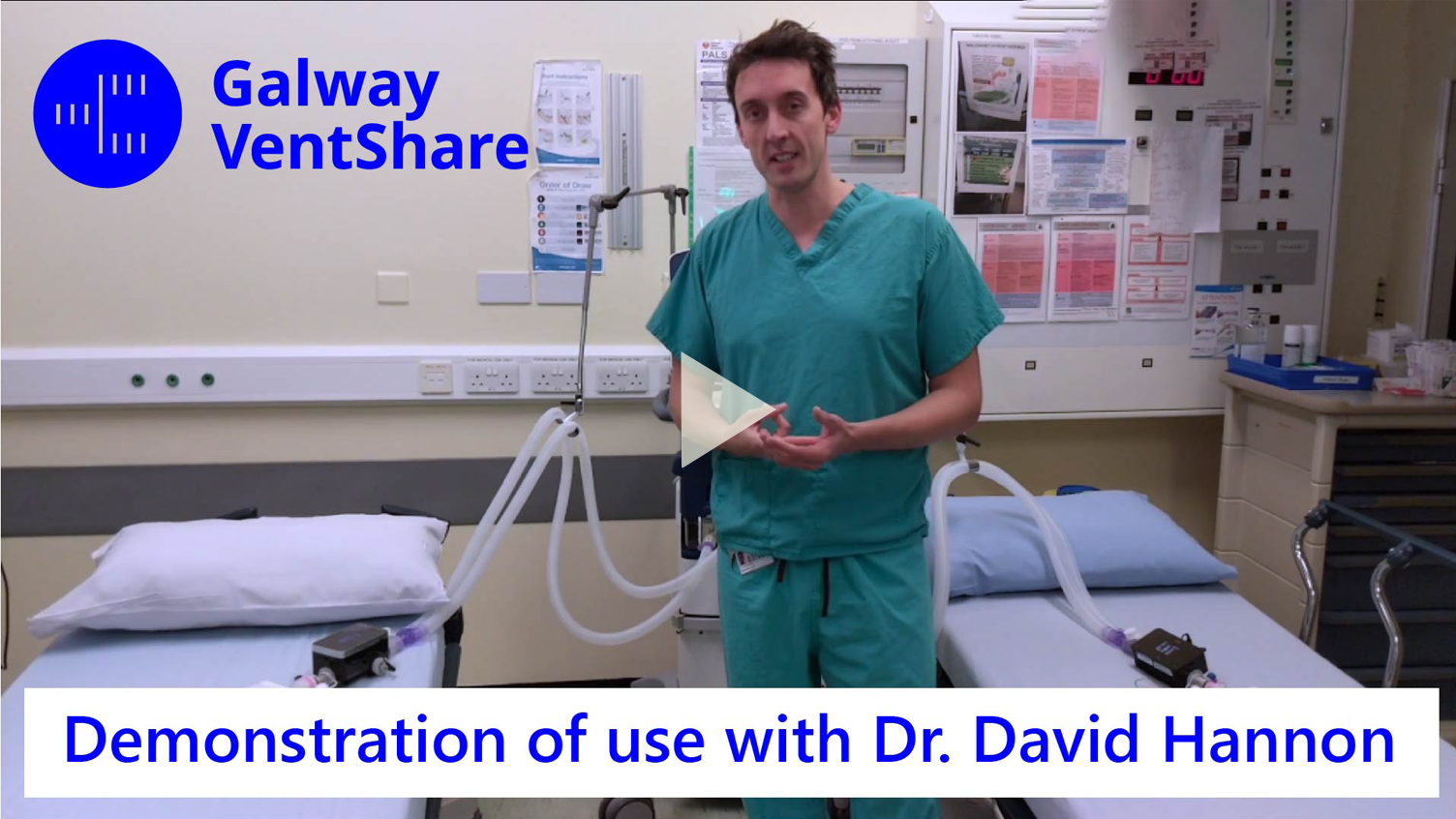
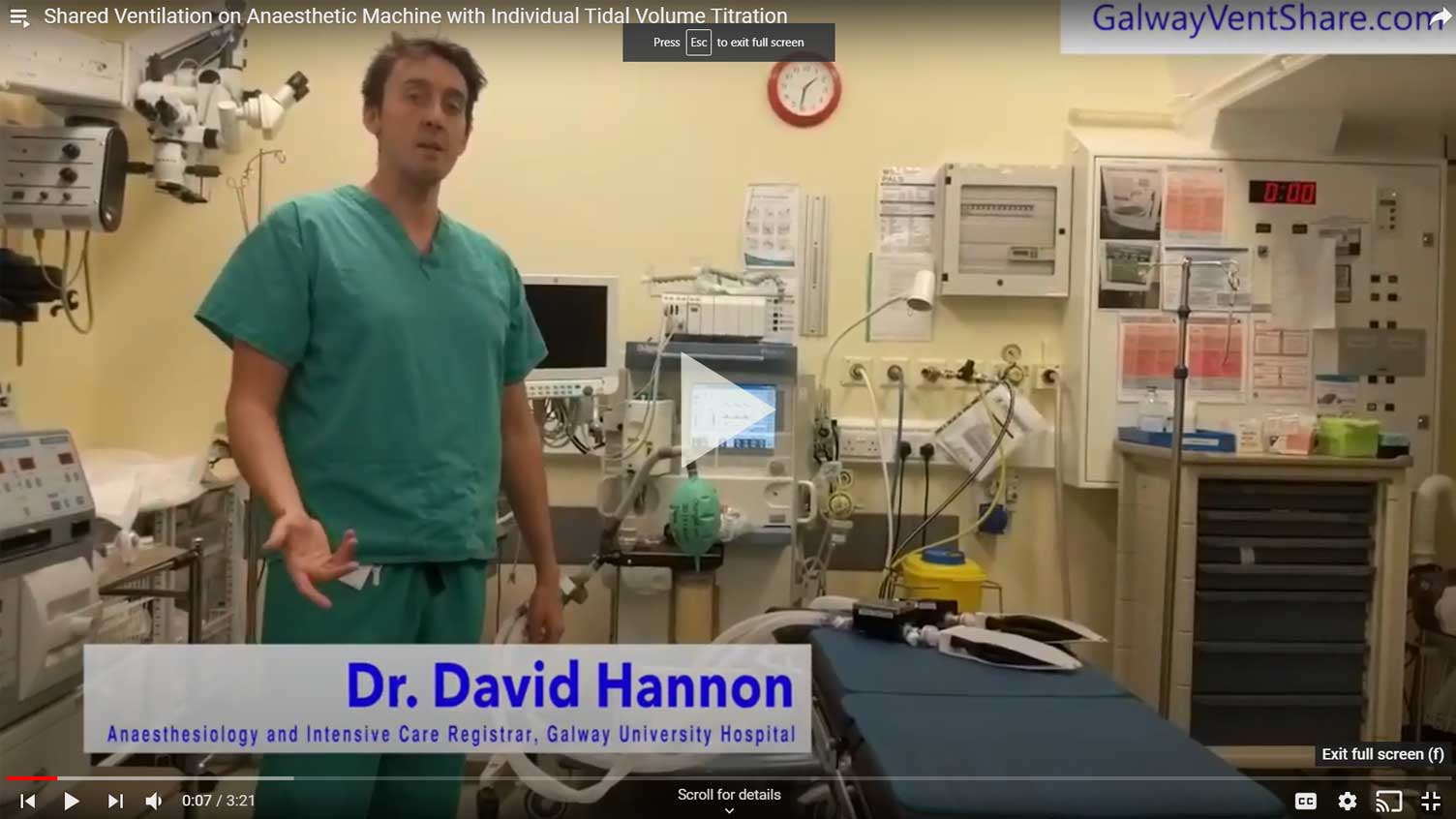
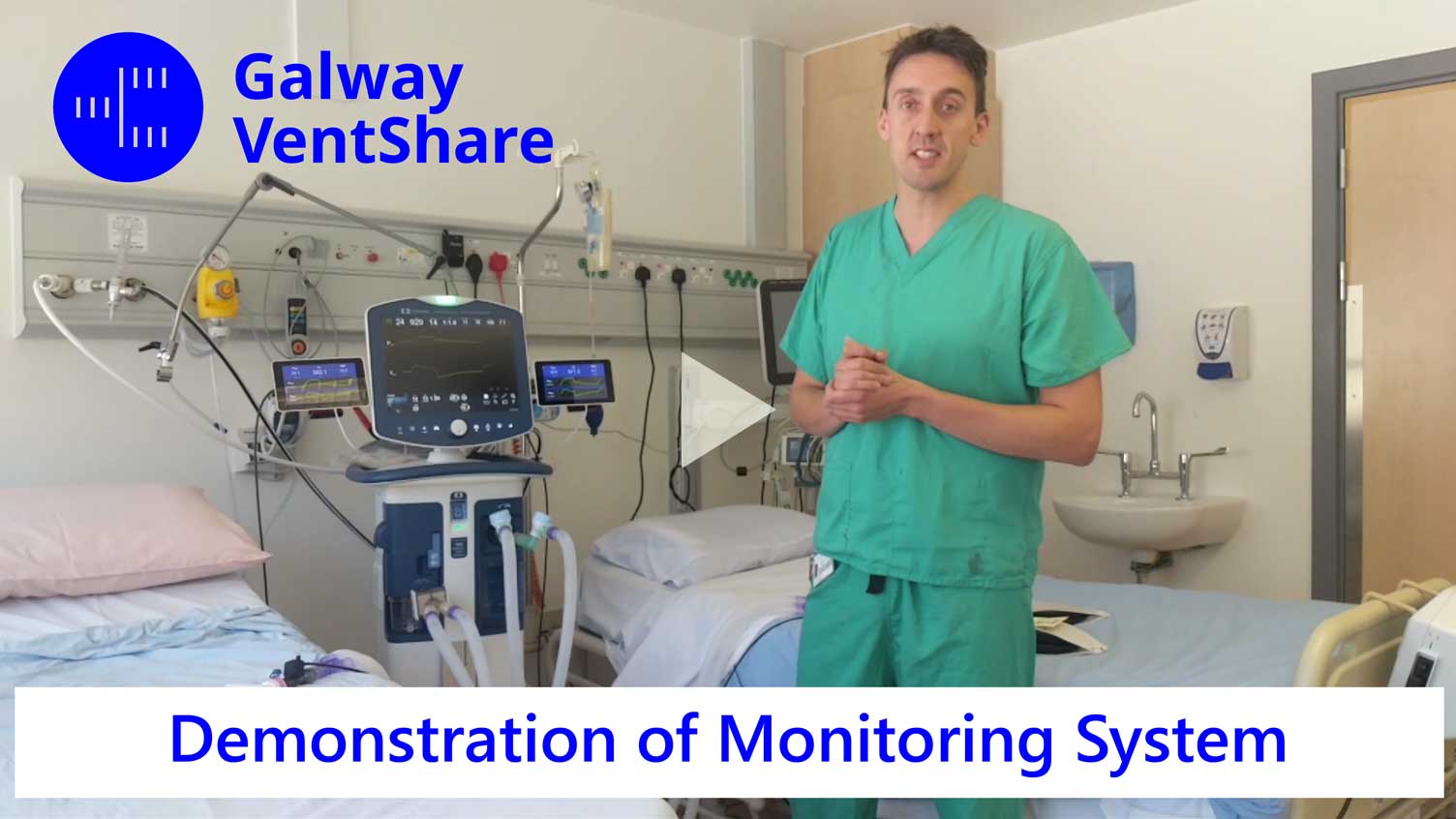
Dr. David Hannon demonstrates how to safely share an invasive ICU ventilator between two patients, with individual tidal volume control
“You must be the first mover…Speed trumps perfection.”
Michael Ryan WHO 2020
As part of a rapid-response initiative to the COVID-19 pandemic, Engineers, Clinicians and Academics in Galway (NUI Galway, NCAD, University Hospital Galway, local Multinational MedTech Companies and MedTech Start-Ups) have swiftly come together to collaborate on addressing unmet needs in the evolving global crisis and to implement rapid solutions.
The Inspire Initiative has a number of projects spanning the journey of the virus from transmission to critical care and recovery, the teams have rapidly developed, verified and are now implementing solutions that will support >our health care workers to respond to this unprecedented challenge.
The Galway VentShare team was tasked with investigating a safer way to ventilate multiple patients from a single ventilator. The team is led by Tim Jones & Jack Connolly (Engineering) and Dr David Hannon & Professor John Laffey (Critical Care) with technical support from Aerogen.
Need: A way to increase ventilator capacity for ARDS patients in extreme circumstances where there are no other options available.
Taking into account the emerging data on safety and efficacy concerns the team have, after two weeks of intensive design and testing, developed a system which can provide independent tidal volume titration to two patients.
All work on this project has been completed on a voluntary basis and the aim of this website is to freely share the information in order to speed up the development of solutions.
Other Initiatives
A large volunteer group from the Medtech industry in Galway came together to deliver two projects outlined below. Click on the links for further details about the projects and instructions on how to build the solutions.
Repurposing home bipap/cpap machine for covid-19 patients
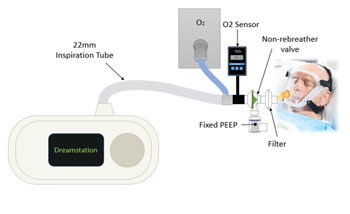
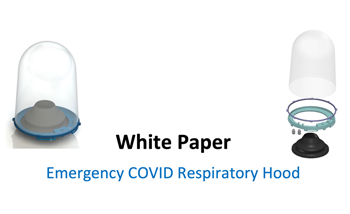
Low cost Cpap hood
We have also worked with other shared ventilation projects around the world. The links are detailed below.
Other Shared Ventilation Projects
- Mount Sinai & Stryker
- New York Presbyterian & Columbia University
- Yale University
- Team Geel, Belgium
- International Workgroup
- Combilift
Disclaimer
Please note that our research and the information provided herein has not yet been used in a clinical setting and has not yet received regulatory approval or certification whether CE Mark, FDA approval or otherwise. Use of the information in a clinical setting will require you to obtain approval, prove safety and efficacy and/or superiority to other medical devices and obtain all regulatory and ethical approvals required in each county or territory in which you intend using the solution. The content provided may be incomplete or incorrect.
The Galway Vent Share Group (to be defined and clarified) is a not-for profit organisation and does not assume any liability and has no responsibility for the payment of any damages, of any kind (including claims arising out of or related to product liability, negligence, failure to warn, warranty, use or inability to use, regardless whether or not the Galway Vent Share has been advised of the possibility of any such damages or liability), for your use of the solution (inclusive of any software) manufactured by any participant or any other third party based on or derived from the protocol provided or the manufacture, maintenance or support or use of your vent share of or any other ventilator (inclusive of any software) by any participant or any third party. The use of the protocol and the manufacture of your solution is at your own expense and risk and is intended solely to assist with the public health and medical response to the COVID-19 pandemic.